Sovereign Driver
A doctrine-of-God record on Tool-heavy prog and baroque hard rock: the God who owes nothing to anyone, descending in the dark all the way to death — the Sovereign Driver who becomes the Sovereign Diver. From aseity, through the eternal decree, down to the incarnation and up to the throne of the slain Lamb.
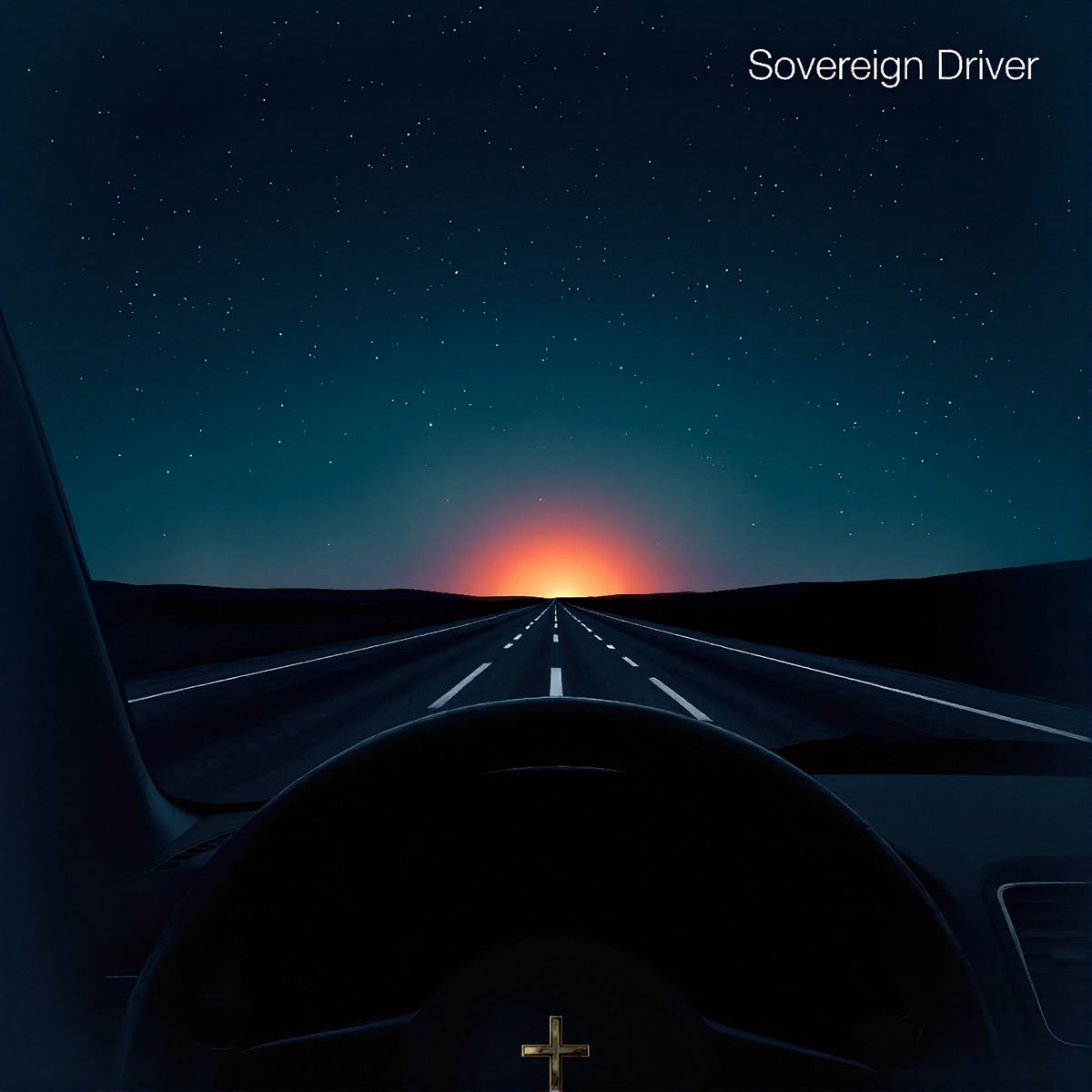
Begin with the cover. A car at night on an empty highway, the dashboard dark, a small cross fixed to it, the road running straight out ahead until it vanishes into a thin band of fire on the horizon — not headlights, not a town, but the first rumor of a dawn that hasn’t arrived. You are not driving. Someone else has the wheel. And the first thing to know about this record is that the hands on that wheel are scarred.
It’s an album about the God who does not need you becoming the God who came down to get you.
Listen for the drive underneath it all — the steady, unhurried pulse of a long road taken at night, motion without hurry, never quite arriving. That groove isn’t only atmosphere; it’s the doctrine. It is providence you can feel: you are being carried, at a pace you did not set, toward a light you cannot yet reach.
Aseity, the Christian doctrine of God — from-himself-ness, the life God has in and of himself, owing nothing to anything outside him. Without body, without parts, without passions worked on him from the outside; not lonely before he made the world, not waiting on it, not becoming anything he was not already. You’re meant to feel the altitude — the air is thin up there. Everything that follows is a descent from that height.
From that height, the God who needs nothing does something strange: he drives. “Sovereign Driver” puts you in the passenger seat of providence — the night highway, the engine’s steady breath, the far light that is “light for now, not the end,” every mile a means of grace, every curve held in place, the whole route “set in will before time began.” You are carried through the dark by a grip you cannot see and are asked to trust anyway. Faith, not sight.
And here is the secret the album is built around and never says out loud. In Miracles, reaching for a way to describe what happened when God became man, C. S. Lewis pictured a diver — stripping off, poised a moment in the air, then plunging out of the light down through the warm water into the black and freezing dark, down to the mud and cold at the very bottom, and then rising again, lungs bursting, up into color and air, holding the thing he’d gone down to bring back: “the dripping, precious thing.” The Sovereign Driver is the Sovereign Diver. The one with his hands on the wheel is the one who went all the way down.
“Scarred Hands” is where a person finally speaks. Every other voice on the record describes God; here, for one song, someone admits what they came in needing — “I have needed a hero my whole life” — and the two heroes on offer, the one out there and the one in the mirror, both turn out to be lies. What breaks it open isn’t a new hero but an old name heard a whole life without being seen: Alpha and Omega, Lion and Lamb, who “holds the world with scarred hands.” That’s the hinge. Sovereignty was never the opposite of suffering; on this record they are the same two hands.
Then the descent goes to the floor. “All Came to Pass” is the decree — the end declared before the beginning, no counsel split, no chance unthrown, nothing running free of the throne. The whole album was born here: in a season spent in the fall of 2025 on the doctrine of the divine decree in Ephesians — the God who works all things after the counsel of his own will, who chose a people in him before the foundation of the world. And “Low Enough” is the plunge itself: the one who upholds all things by a word going lower than the angels, lower than the sky, lower than the clay he formed — “low enough to die.” Not a robe pulled on over a god who only seemed to bleed, but real flesh, real thirst, real dust. “The hands that hold the stars were held.”
Then the ascent. The Colossians hymn names what the Diver was doing down there — in him all things hold together, and through the blood of his cross all things are brought home. “In Him” is the surfacing: everything true of him becoming, by grace, true of us — chosen before our breath, drawn into another throne, “welcomed in as sons.” Not the gift but where it goes; not the road but where it leads. And it won’t end on us: “not for us to end the song, but to join what’s going on.”
So the record ends where it was always headed — at the throne, in John’s vision, with a scroll no one in heaven or on earth is worthy to open. That scroll is the sealed decree, the very thing “All Came to Pass” sang — God’s whole sovereign purpose, shut with seven seals. And the album’s full weight comes down on the reason one figure, and only one, can break them: for you were slain. The pierced hand is the worthy hand. The Diver surfaces holding the opened scroll and a people purchased “from every tribe, every tongue, every people, every nation” — and the room that began with a single austere voice saying not waiting, not becoming ends in the roar of ten thousand times ten thousand and every created thing, all saying the same word: worthy.
Play it from the top, in the dark if you can. Let it get cold before it gets warm. That’s the whole point.
Study the songs
Listen to each song with the lyrics, scripture references, and additional teaching aids.